


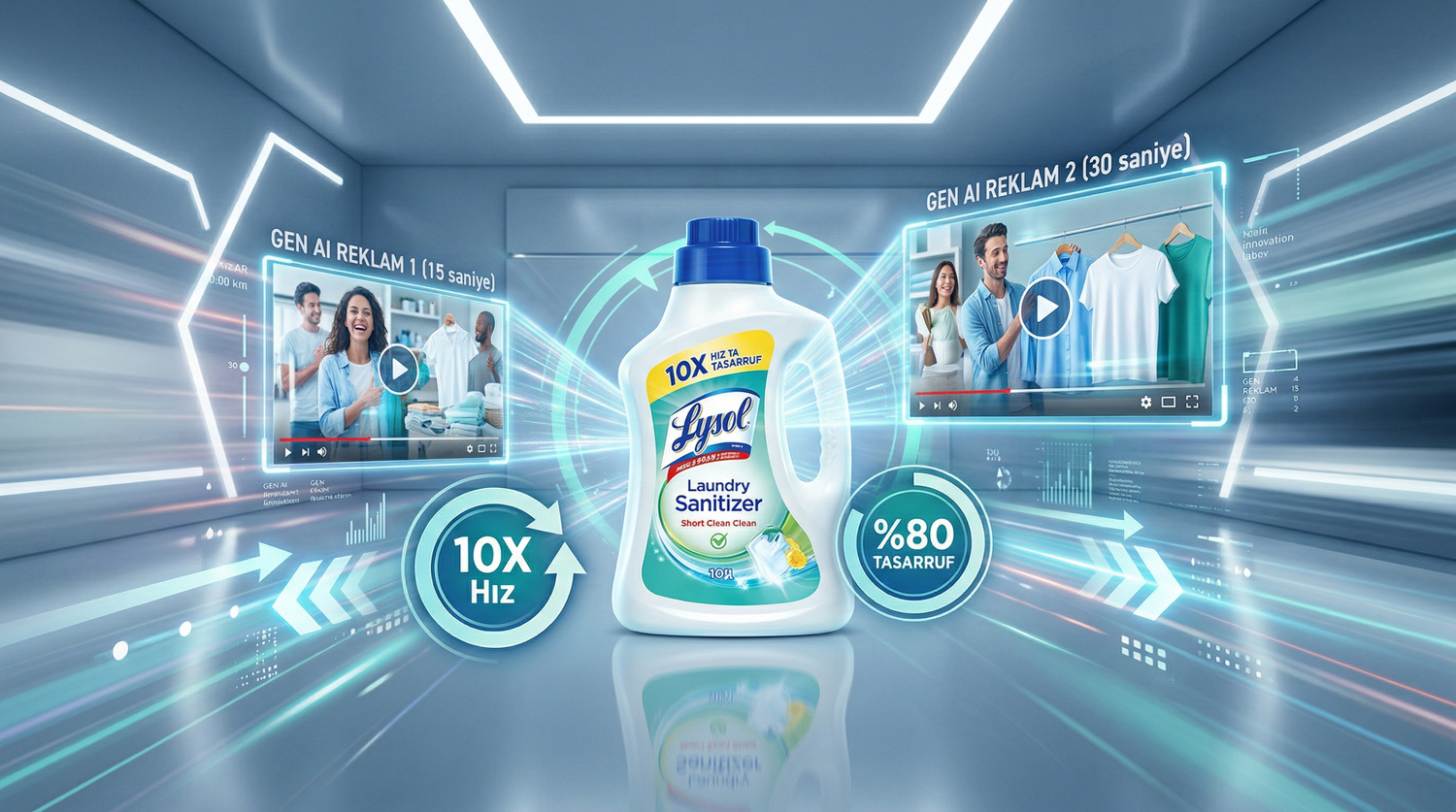
While the promises of generative AI (Gen AI) are compelling, simply experimenting with these tools is not the same as producing an AI-generated, ready-to-broadcast ad campaign. The brand that took on this challenge launched a pilot project using end-to-end generative AI to create powerful assets that resonated with their target audience, increase quality, and accelerate time-to-market.
From Bottleneck to Peak: The 8-Week Sprint Process
Lysol’s objective in this “test-and-learn” focused challenge was very clear: create broadcast-ready 15- and 30-second commercials within a short 8-week sprint. The campaign’s focus was Lysol Laundry Sanitizer. Added to laundry routines, this product kills 99.9% of bacteria, and its communication strategy was shifted from “disease prevention” to “neutralizing stubborn bad odors” — reminding consumers that odors are caused by bacteria, not sweat.
Phase 1: AI-Accelerated Ideation
The process, which began with a BCG and Google collaboration, used Gemini to rapidly analyze consumer trends and competitor positioning, then generate and score hundreds of concepts. The team manually selected the three most promising routes, reducing the ideation process — which would normally take weeks — to hours. From the very beginning, a responsible AI policy was adopted, working with consenting and paid real actors and creating their “digital twins” (AI likenesses).
Phase 2: Synthetic Production and Filming
Costly physical filming processes were skipped entirely, moving directly to synthetic production with Veo and Imagen tools. This step enabled extremely fast revisions.
Of course, every output wasn’t perfect on the first try; initial drafts featured white-coated technicians running in labs or cartoonish bacteria resembling comic book characters rather than smelly microbes. However, with careful “re-prompting” operations, the targeted look and feel was quickly achieved.
Phase 3: 2-Week Rapid Optimization
In the final phase, Veo was used again to rapidly produce creative variations and test them directly with consumers. Approving the launch-ready final creative assets took only two weeks. The point at which most brands’ ad production schedule gets stuck became an express lane thanks to Google’s AI-powered tools.
Triple Win: Cheaper, Faster, and Equal Quality
This pilot project proved that generative AI tools provide tremendous operational power in marketing. Traditionally, the creative production process is bound by “iron triangle” rules: you can choose only two of Speed, Quality, or Cost. With AI, this rule is now becoming history.
Speed and Agility Advantage: The time from briefing to launch was dramatically reduced. This speed allows the brand to capitalize on micro-trends and deliver custom content for specific audience segments in near real-time. Speed is no longer a constraint but a competitive advantage.
Cost Revolution: Cost per asset decreased by 80% compared to traditional process. These figures confirm that AI tools are not just a niche efficiency tool but a transformative solution for high-volume content needs.
New Standard – Quality Parity: The question “Can generative AI produce both fast and quality work?” was answered with data. According to short-term sales lift analyses, the best AI ad created almost exactly the same impact as the best traditional ad.
The New Era Strategy for Marketing Leaders
We’re moving beyond just experimentation now. Lysol’s success shows that the “iron triangle” of speed, quality, and cost is broken. For marketers wanting to integrate AI into their processes, this roadmap is no longer theoretical; it’s entirely concrete, actionable, and right in front of you.